
What 462 TH/s Earns Before the Power Bill
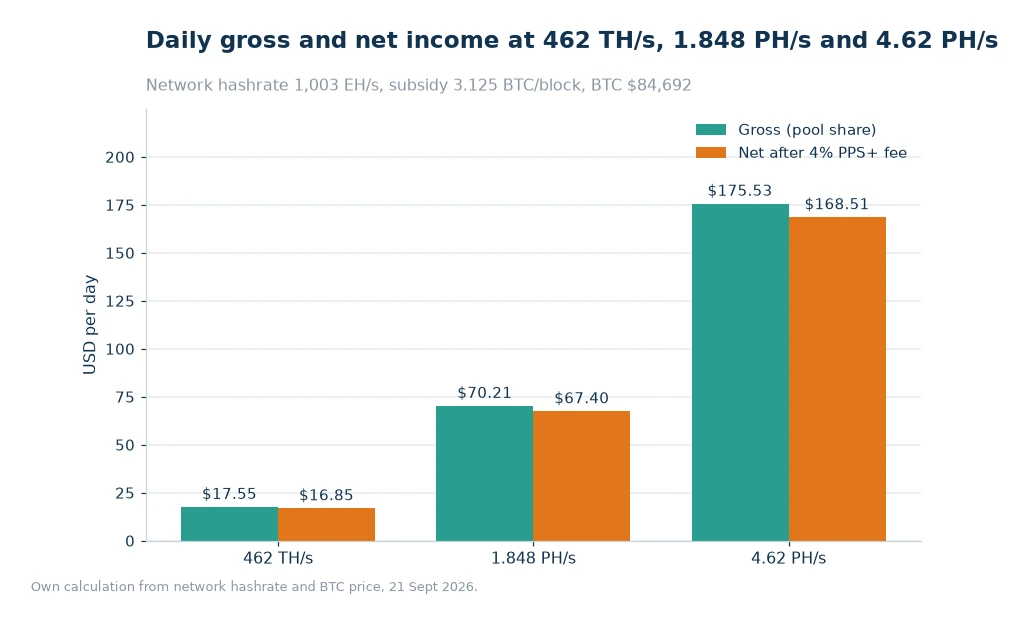
Gross income is the number a pool quotes; net income is the number a miner lives on. At 462 TH/s, current network conditions produce 0.00020726 BTC a day, worth $17.55 at $84,692 per BTC, and $16.85 after the listed 4% on the block-reward component. The gap to the power bill is what decides whether the rig stays switched on.

Key takeaways
- At 462 TH/s, daily output is 0.00020726 BTC, or $17.55 gross and $16.85 net of the listed 4% on the block-reward component.
- At 4.62 PH/s the same inputs give 0.00207256 BTC a day, $175.53 gross and $168.51 net.
- Power is a separate cost from the pool fee, and it is the one that decides whether a marginal rig runs.
- The listed rates are 4% on the PPS-settled block reward and 2% on the transaction-fee component under PPS+, or 2% on both combined under PPLNS.
Gross is not what the rig keeps
A pool payout starts with a simple fraction: your hashrate divided by the network's, multiplied by the coins issued each day. That gives the gross figure, and it is the same calculation whether you run one machine or a warehouse. The deductions come afterwards, and they are not all pool fees. Power, cooling, hosting and hardware depreciation sit outside the pool statement, which is why a rig can look profitable on a calculator and still lose money in a room.
The clean way to compare is to put every cost on the same daily line. Gross BTC, the listed pool charge, the power cost in dollars, and the net that remains. Once those four numbers sit together, a change in BTC price or difficulty can be applied to one line and the effect on the others is obvious. Mixing percentages with monthly invoices is where most estimates go wrong.
Where the 462 TH/s figure comes from
The output follows directly from the network inputs. With 1,003 EH/s of total hashrate and 3.125 BTC per block across 144 blocks, the network issues 450 BTC a day. Your share is 462 TH/s divided by 1,003,000,000 TH/s, and that share times 450 BTC is the daily gross. There is no pool-specific multiplier in the formula, though the payment method changes which listed rate applies.
That formula is the basis for the ViaBTC Bitcoin Mining setup, where PPS+ is the default and settles hourly against current difficulty. PPLNS is the alternative: it pays after 6 confirmations and allocates each miner a slice based on their share of pool hashrate across the last 5 difficulty rounds. The coin count before fees is identical; the timing and the listed rate are what differ.
Three hashrate tiers, one set of inputs
The tiers below are all exact multiples of 462 TH/s, which makes the pattern easy to audit. Doubling or tenfolding the machine count doubles or tenfolds the BTC and the dollars, because the network share scales in a straight line.
| Hashrate | BTC per day | Gross USD per day | Net USD per day |
|---|---|---|---|
| 462 TH/s | 0.00020726 | $17.55 | $16.85 |
| 1.848 PH/s | 0.00082911 | $70.21 | $67.40 |
| 4.62 PH/s | 0.00207256 | $175.53 | $168.51 |
The middle row is four times the first, and its gross is four times $17.55, which is $70.20 before rounding. The last row is ten times the first, and its gross is ten times $17.55, or $175.50 before rounding. Those clean ratios are a useful check: if a quoted figure does not scale this way, one of the inputs has changed.
Power is the second deduction
A modern ASIC draws a fairly steady number of watts, and the power cost per day is the wattage times 24 hours times the local rate. That cost does not care about BTC price. When the price falls, the dollar income shrinks and the power bill stays where it was, so the margin compresses from both ends. This is why the same machine can be comfortable at one price and marginal at another without any change to its efficiency.
Put the power cost beside the net figure, not the gross. At 462 TH/s the listed 4% takes about $0.70 a day, leaving $16.85. If the rig draws enough power to cost $12 a day, the true margin is under $5 before cooling and maintenance. That remaining figure is what pays for a replacement fan or a new hash board, and it is the number that should drive the decision to keep running.
Why network conditions matter more than the sticker
Every figure in this article rests on a network hashrate of 1,003 EH/s and a difficulty of 132.76 T, both read on 21 Sept 2026. The next difficulty estimate is minus 2.12%, which would lift output per terahash a little. A subsequent rise in network hashrate would push it back down. The direction of the next adjustment is an estimate, not a guarantee, and the effect on a single rig is small compared with a move in BTC price.
That is the argument for checking the inputs rather than memorising the output. A 462 TH/s machine purchased when the numbers looked one way may look different six weeks later. The formula does not change, so the same worksheet can be updated with three new numbers and give an answer you can act on the same afternoon.
Worked example
Take 462 TH/s and follow the chart note line by line, with the inputs read on 21 Sept 2026.
- Daily BTC per TH/s is 450 divided by 1,003,000,000, which equals 4.4865e-07.
- Multiply by 462: 4.4865e-07 times 462 equals 0.00020728 BTC, shown as 0.00020726 after rounding.
- Multiply by the BTC price: 0.00020726 times $84,692 equals $17.55 gross.
- Apply the listed 4% to the block-reward component: 4% of $17.55 is $0.70, leaving $16.85 net.
- Scale to 1.848 PH/s, which is 1,848 TH/s: 0.00082911 BTC, $70.21 gross and $67.40 net.
- Scale to 4.62 PH/s, which is 4,620 TH/s: 0.00207256 BTC, $175.53 gross and $168.51 net.
- Check the tenfold ratio: $17.55 times 10 equals $175.50, and the $0.03 difference is rounding in the daily BTC figure.
Check the machine against the market
The Miner Profitability Ranking is a fast way to see how a specific model compares at current price and difficulty, and it keeps the comparison on one basis instead of mixing vendor claims. Use it to narrow the shortlist, then run the daily arithmetic above on the exact hashrate you plan to deploy. A ranking is a starting point, not a substitute for your own power rate.
Write down the gross, the listed charge, the power cost and the remainder. If the remainder is positive after a realistic difficulty estimate, the rig has a case. If it depends on a price rise to break even, the case is a price bet rather than a mining plan, and it should be described that way before any hardware is ordered.
Frequently asked questions
Is the $17.55 figure per day or per month?
It is per day at 462 TH/s. Multiply by 30 for a rough month, which gives about $526.50 gross before power, hosting and any other cost outside the pool statement.
Does the listed 4% apply to the whole payout?
No. Under PPS+ the listed 4% applies to the PPS-settled block-reward component, while the transaction-fee component carries a listed 2% under its PPLNS distribution. The two rates hit different parts of the reward.
Why is net income exactly 96% of gross?
Because the example applies only the listed 4% charge to the block-reward component. Transaction fees and their separate listed rate are not included, and power is a further deduction that this figure does not cover.
Run the four-line worksheet
One line for gross BTC, one for the listed pool charge, one for power in dollars, one for what remains. The first two come from the formula and the fee schedule; the last two come from your own meter and contract. Update the worksheet when difficulty changes or when the price moves enough to matter. The rig does not need a story about the market, only a remainder that stays positive.
Sources: the ViaBTC homepage for the pool setup and the fee schedule for the listed 4% and 2% rates. Network hashrate 1,003 EH/s, difficulty 132.76 T, subsidy 3.125 BTC per block, 450 BTC daily and BTC $84,692 were read 21 Sept 2026, published 22 Oct 2026[1]. Every dollar figure is arithmetic on those inputs and moves when they move.