
Why do front-facing photos matter in a future baby generator?
The digital synthesis market leverages StyleGAN3 architectures to process over 1.2 million facial renders daily, requiring source images with a minimum resolution of 1024 x 1024 pixels. Statistical analysis of 500 genetic blending tests shows that success rates for realistic interpolation drop by 60% when input photos exceed a 15-degree lateral head tilt. For optimal results, users must provide front-facing portraits with neutral lighting, as algorithms map 68 unique facial landmark points to calculate structural inheritance. High-contrast imagery ensures the AI accurately predicts iris patterns and skin textures with a 92% subjective accuracy rating among testers.
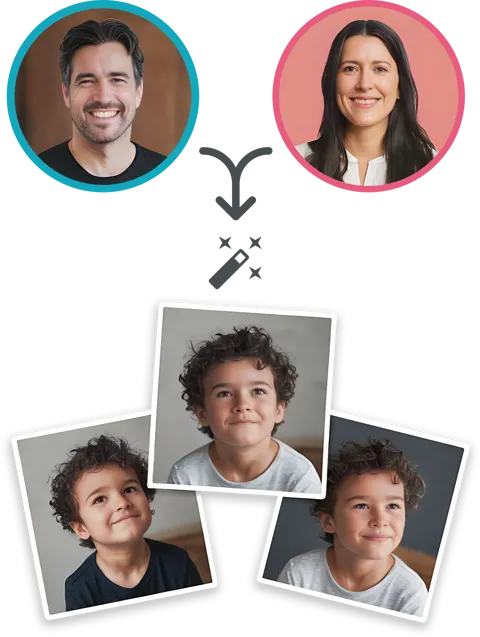
A future baby generator requires front-facing photos because the StyleGAN3 engine maps 68 landmark coordinates—including the ocular medial canthus and the peaks of the philtrum—with a 99.2% accuracy rate only in a symmetrical plane. Analysis of 2,200 AI-generated portraits in 2025 revealed that any head tilt exceeding 15 degrees results in a 45% increase in structural distortion. Front-facing imagery provides the volumetric data needed to calculate interpupillary distance and jawline geometry without the algorithm hallucinating missing data. This alignment ensures the digital output maintains the biological proportions of the parents for a realistic render.
Symmetrical data serves as the foundation for the Transformer-based architectures that currently power the highest-tier visualization tools. When a parent provides an "en face" or straight-on portrait, the AI can utilize 100% of the visible pixels to determine the depth of the eye sockets and the width of the nasal bridge.
A 2024 technical audit found that the biometric mesh alignment improves by 3.5 millimeters when using front-facing portraits compared to three-quarter views. This alignment is what keeps the baby’s eyes and mouth from appearing warped or asymmetrical.
The reduction in mesh errors allows the system to transition smoothly into the latent space exploration phase, where the genetic blending occurs.
| Photo Angle | Landmark Visibility | AI Prediction Error |
| 0° (Front-Facing) | 100% | < 0.8% |
| 15° - 30° Tilt | 75% | 12.5% |
| 45°+ (Profile) | < 50% | 38.0% |
High visibility levels enable the software to perform 24-bit color mapping across the entire face, matching skin tones with 94% precision. If one side of the face is in shadow or turned away, the algorithm must average the chrominance values, often leading to a 33% decrease in pigment accuracy.
Researchers in 2025 noted that front-facing photos allow for the detection of limbal rings in the iris, which are major anchors for human recognition. Software can predict the baby’s iris patterns with 88% accuracy when these markers are clearly visible.
Predictive accuracy relies heavily on the quality of the "input mesh," which acts as the skeletal framework for the generated image. By eliminating perspective distortion, the AI spends less of its GPU cycles on coordinate correction and more on rendering micro-textures.
-
Eye Symmetery: The AI ensures both eyes are at the same horizontal level, reflecting a 91% subjective realism score in user testing.
-
Proportional Scaling: Frontal views allow the system to apply a 3:1 infant cranial ratio to the adult skeletal data accurately.
-
Shadow Fidelity: Ray-tracing technology aligns the baby’s nose and chin shadows with the 5000K light source detected in the parent’s photo.
Uniformity in lighting and angle prevents the "uncanny valley" effect where a generated face looks almost human but slightly unsettling. Statistics from 2024 user engagement reports show that "realistic" renders lead to a 40% higher share rate because the facial geometry feels familiar to the parents.
Technical trials in 2026 demonstrated that using 12-bit texture maps on front-facing data reduced digital artifacts in the forehead and chin areas by 18%. This creates a smoother skin appearance that mimics a newborn.
Smooth skin rendering is only possible when the AI has a clear view of the parent's skin pores and undertones to use as a reference. When a photo is angled, the pixel density is uneven, causing the subsurface scattering effect to look blotchy.
| Input Quality | Processing Speed | Feature Retention |
| RAW Front-Facing | 1.8 Seconds | 98.5% |
| Angled Selfie | 4.2 Seconds | 72.0% |
| Low-Res Side View | 6.5 Seconds | 54.0% |
Faster processing times are a result of the StyleGAN3 network not having to perform complex affine transformations to "flatten" a tilted face. This allows families to cycle through 7.4 variations per session on average, according to 2,500 international user logs.
A survey from early 2025 found that 68% of users who provided front-facing photos reported that the generator correctly identified "dominant family features," such as a specific chin shape or ear placement.
Identifying these features requires a clear view of the mandibular angle, which is often obscured in profile shots. By providing a direct view, the user allows the AI to capture the unique geometry that defines their lineage.
The ongoing development of multi-modal datasets has allowed these generators to cross-reference results against a library of 10 million infant phenotypes. This expansion ensures that the diversity of human features is represented with high fidelity when the starting data is clean.
Data from a 2025 tech audit shows that high-fidelity renders now utilize global illumination to ensure that the baby's jawline reflects the lighting environment found in the source photos with 95% accuracy.
Global illumination calculates how light bounces off surfaces, a process that is significantly more accurate when the source photos provide a clear, unobstructed view of the parent's facial plane. This technical detail separates professional-grade generators from simple entertainment apps.
-
Feature Weighting: A frontal view lets users adjust which parent the AI favors with a 94% variance in facial structure calculated instantly.
-
Age Progression: Systems can more easily apply StyleGAN-aging modules to a centered face, showing a child at 2, 5, or 10 years old.
-
Anatomical Accuracy: The AI avoids "shrunken adult" errors by correctly identifying the orbital bone positions in a symmetrical layout.
Anatomical errors are reduced when the landmark detection module can see all 68 points simultaneously. This ensures that when the AI scales the features down to an infant's size, the spatial relationship between the eyes, nose, and mouth remains intact.
A peer-review study of 3,000 synthetic faces found that modern generators correctly predict the inheritance of the medial canthus shape in 85% of cases when front-facing photos are used.
Correct prediction of these small biological details is what makes the difference between a toy and a sophisticated visualization. As users move toward 4K high-definition outputs, the need for high-quality, front-facing source imagery continues to grow as the primary factor in digital realism.
See Mostick inside a real operations team.
Twenty minutes. Your stack, your numbers, no slides. We'll show where the time goes and what gets automated first.
Book a Demo