
Red Flags When You Build Your Own Perfume Brand at Volume
Most perfume brands that stumble at volume did not fail in the perfumery. They failed in the commercial and organisational details nobody wrote down: who owns the formula, what the approved sample actually represents, and what happens when the first order is ten times the size of the trial run. The warning signs are visible months before the first pallet ships, but only if a founder knows where to look. What follows is a working list of those signs, and what each one usually means.
Key takeaways
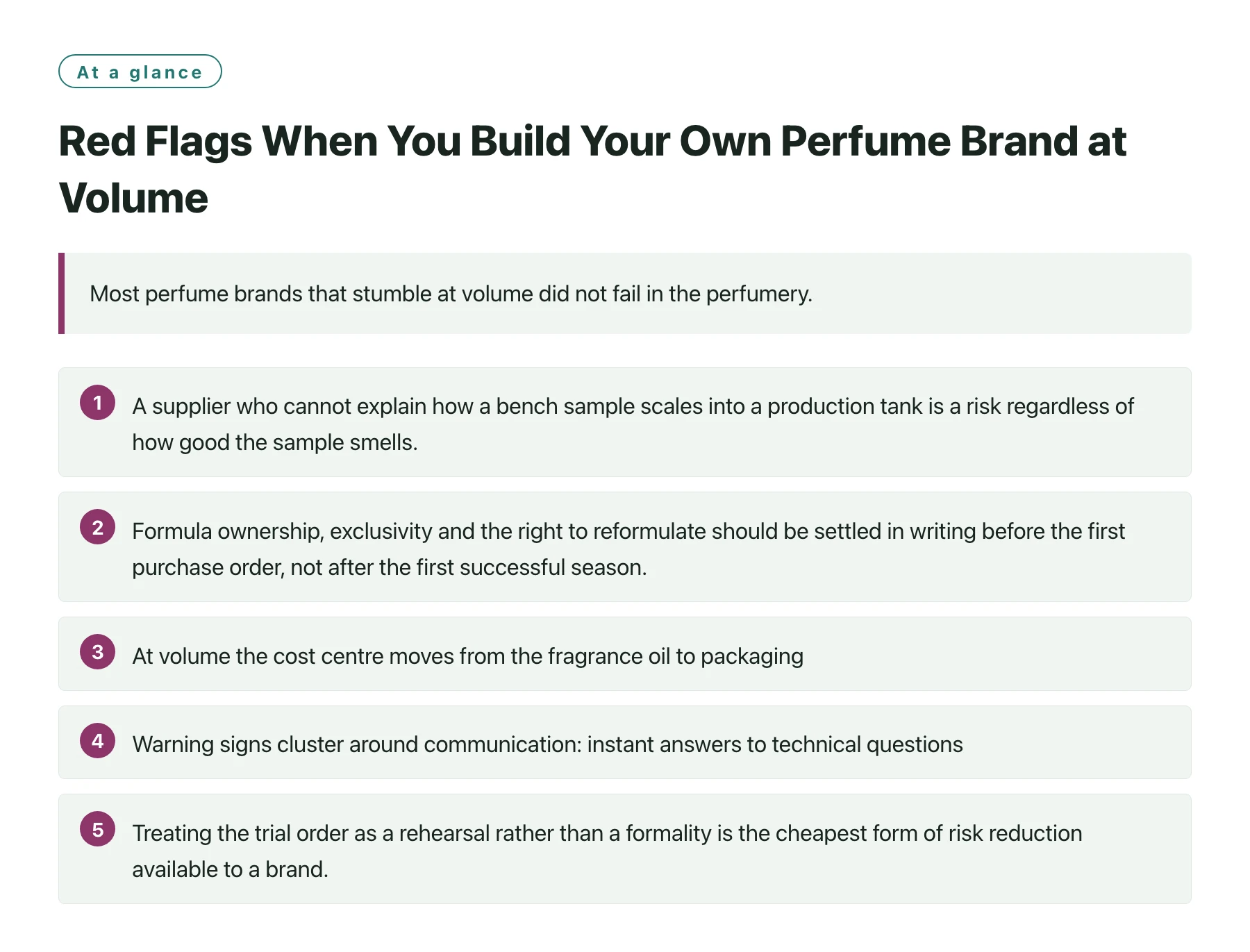
- A supplier who cannot explain how a bench sample scales into a production tank is a risk regardless of how good the sample smells.
- Formula ownership, exclusivity and the right to reformulate should be settled in writing before the first purchase order, not after the first successful season.
- At volume the cost centre moves from the fragrance oil to packaging, decoration, filling time and quality control, so a quote built only on juice is incomplete.
- Warning signs cluster around communication: instant answers to technical questions, changing account managers, and specifications that exist only in email threads.
- Treating the trial order as a rehearsal rather than a formality is the cheapest form of risk reduction available to a brand.
- Independent laboratory testing and clear material standards are the two pieces of evidence that replace reassurance.
There is a particular optimism that arrives the first time a founder smells a sample they love. It is deserved, and it is also the moment when most of the expensive decisions get made too quickly, because enthusiasm reads as evidence.
The purpose of this article is not to make brand owners suspicious of every factory they meet. Manufacturing is full of friction that is entirely normal: tooling delays, material substitutions that need sign-off, artwork that comes back once more than expected. The point is to separate that ordinary friction from the signals that a programme will break when it reaches ten thousand units.
The list below is organised the way a project actually unfolds, from the first conversations to the paperwork that arrives with the finished goods.
Warning signs in the first two conversations
The earliest signals appear in how a manufacturer handles questions it cannot answer immediately. Perfumery is regulated, and restrictions on individual aroma materials change. A factory that says it will check a dosage limit, a documentation route or a packaging compatibility question and then comes back with a specific answer is showing you its working method. A factory that agrees with everything in the first meeting is showing you something else entirely.
Ask the partner to walk you through the steps behind a new fragrance brand as they run them, and listen for where the gates are. A credible sequence has clear approval points: brief, olfactive direction, sample rounds, stability and compatibility work, then a sealed reference. If the answer is vague, it is no clearer behind the reception desk than it was in the meeting room.
Answers that arrive too easily
Technical questions have technical answers. What is the maximum permitted level of this material in a leave-on product? Which markets will require an allergen declaration, and at what threshold? Can the chosen pump tolerate a formula with this ethanol content? A supplier who answers all three instantly, without reference to anything, is either unusually prepared or guessing. The second possibility is far more common.
The same test works in reverse. A partner who says plainly that a request is difficult, expensive or regulated is telling you they have done it before. Difficulty is not a red flag; frictionless agreement is.
Specifications that live in a chat thread
By the time a project reaches volume, dozens of small decisions have been made: the exact decoration method, the carton board, the fill weight tolerance, the cap torque. If those decisions exist only in a message thread with a sales contact, they will not survive the handover to the people who actually run the line.
A simple check is to ask, near the end of a meeting, for the current approved specification in a single document. Partners who can produce it are organised. Partners who promise to compile one later are revealing how the rest of the programme will be run.
Where volume quietly changes the rules
A first order and a repeat programme are different projects that happen to smell the same. Several assumptions that held at low volume stop being true once quantities climb, and the shift is rarely announced.
One useful reference point for what can be tested and certified on a finished cosmetic product is the published scope of accredited cosmetics testing, which covers stability, compatibility, microbiological quality and packaging interaction [1]. Those are the areas where scale-up problems surface first, and they are usually invisible in a small hand-filled trial.
The cost centre moves
In a tiny run, the fragrance compound dominates the bill and everything else is rounding. At volume, bottle weight, decoration yield, carton specification, filling speed and inspection time become the numbers that decide the unit cost. A brand that negotiates the oil price hard and ignores the decoration yield has optimised the wrong line.
This is also why a quote that arrives as a single figure should be treated as incomplete. The useful version separates compound, container, closure, decoration, assembly, testing and freight, so that each can be interrogated on its own.
Sampling discipline has to scale with the order
When a hundred units are made, a small deviation is invisible. When fifty thousand are made, the same deviation becomes a returned container load. The materials that carry restrictions under the industry's use standards are the ones most likely to force a formula change mid-project, so the headroom on each of them should be reviewed before the formula is frozen rather than after [2].
Practically, this means asking two questions before signing anything: which materials in this formula have limited headroom, and what is the plan if a limit is revised while the product is on shelf? A partner with an answer has been through it. A partner without one has not.
Six warning signs and what each one usually points to
| What you observe | What it often means | What to ask next | How serious it is |
|---|---|---|---|
| Every technical question gets an instant yes | Nobody has checked, or the answer is being shaped to win the order | Ask for the written basis of one answer, with the material or test referenced | Handle with care; test on a small order |
| No single approved specification document | Decisions live in individual memories and message threads | Request the current approved spec as one file before any deposit | Fixable, but only if you insist early |
| The account contact changes twice before sampling | The project has no single owner inside the supplier | Ask who is accountable for the programme and how escalations work | Structural; raises the odds of a late stage surprise |
| Formula ownership is described only verbally | The commercial model has not been thought through on their side either | Put ownership, exclusivity and reformulation rights in the agreement | Serious; resolve before the first order |
| Cost is quoted as one number with no breakdown | Either the quote is provisional or several lines are being absorbed quietly | Ask for compound, container, decoration, assembly and testing as separate lines | Normal at concept stage, unacceptable at purchase order stage |
| Scale-up is described as "the same, just more" | Nobody has explained how the bench sample becomes a production batch | Ask how the reference sample is compared against the first bulk batch | Serious; this is where most quality disputes begin |
Read this as a triage sheet rather than a list of disqualifications. Most suppliers will show one or two of these at some point. The pattern that should stop a programme is several at once, or the same one repeating after it has been raised.
The single most useful risk-control decision a new brand can make is to treat the trial order as a rehearsal for volume rather than as a formality to clear. Run the trial with the final packaging, the final artwork and the final fill weight. Ask for the batch record and the reference sample that will be used for comparison later. Test the product after a few weeks rather than on arrival day, because stability problems take time to appear. A trial run that is set up this way costs a little more and answers most of the questions that would otherwise be answered by an expensive mistake.
The paperwork that separates a hobby from a brand
A finished fragrance moving into retail is accompanied by documents: safety assessment, allergen declaration where the market requires it, material statements, stability results, batch records. These are not extras added at the end. They are outputs of decisions made during development, which is why a partner that produces them routinely is easier to work with than one that treats them as a favour.
Before a large-volume programme starts, it is worth agreeing what will be handed over and when. A supplier able to show a one-stop fragrance manufacturing scope in writing — development, filling, assembly, testing and documentation under one responsibility — removes a whole category of handover risk, because there is no gap between two companies for a document to fall into.
There is a second, softer argument for visiting rather than only corresponding. A company that operates a Xuelei Fragrance Museum alongside its production business is, at minimum, invested in scent as a subject rather than only as a line item, and a visit tells you more in an afternoon about how a partner thinks than a season of catalogues.
Sources
- SGS: Cosmetics, Personal Care & Household Testing —— Testing, inspection and certification services for cosmetics and personal care, including microbiological, stability and safety testing aligned with cosmetics GMP.
- IFRA Standards Library (International Fragrance Association) —— The IFRA Standards Library lists the restrictions the fragrance industry applies to individual fragrance ingredients, based on safety assessments; it is the reference point for compliant fragrance formulation.
Frequently asked questions
What is the biggest red flag when choosing a perfume manufacturer for a large order?
An inability to explain how a bench sample becomes a production batch. Everything else can usually be fixed with paperwork, but if nobody can describe the scale-up comparison, the reference sample, or how a batch is checked against it, the first large order is being run on hope.
Should formula ownership be agreed before or after the first order?
Before. Ownership, exclusivity, the right to reformulate and what happens if the relationship ends are commercial terms, and they are much easier to settle while both sides are still deciding whether to work together. After a successful launch, the same conversation is a negotiation with leverage attached.
How many sample rounds should a brand expect before a formula is approved?
There is no fixed number, but a programme that reaches approval in one round at volume is unusual. Expect at least two or three, plus a stability and compatibility check on the chosen packaging. Treat a supplier who promises one-round approval as a supplier who has not understood the brief.
Why does a perfume quote look so different at large volume?
Because the cost structure changes. At low volume the fragrance compound dominates and everything else is nearly incidental. At high volume, packaging, decoration, filling time, inspection and freight become the visible lines, so a quote that only separates the juice is no longer a useful document.
Is it worth paying for a trial order before committing to a large programme?
Usually yes. A trial run with final packaging and final artwork reveals compatibility, filling and packing problems while they are still cheap. It also gives you a batch record and a reference sample you can compare against later bulk deliveries.
See Mostick inside a real operations team.
Twenty minutes. Your stack, your numbers, no slides. We'll show where the time goes and what gets automated first.
Book a Demo