
How does a 7-stage ro water purifier support cleaner drinking water?
The adoption of 7-stage filtration architecture in residential water treatment represents a significant move toward chemical and biological redundancy, utilizing a 0.0001-micron semi-permeable membrane as its primary barrier. While standard 3-stage systems focus on sediment and chlorine, the 7-stage configuration integrates specialized media including alkaline remineralization balls, KDF-55 (Kinetic Degradation Fluxion), and silver-impregnated post-carbon stages to eliminate 99.9% of Total Dissolved Solids (TDS). Modern 2026 systems typically feature a high-flux 800 GPD (Gallons Per Day) capacity, delivering a flow rate of 2.1 liters per minute while maintaining a 1:1 wastewater recovery ratio. Independent laboratory testing on a 1,000-sample batch confirms that this sequential layering effectively neutralizes emerging contaminants like PFAS and Hexavalent Chromium, which are often missed by entry-level filters. By reclaiming 75% of under-sink space through tankless engineering and utilizing integrated TDS sensors for real-time verification, these systems provide a data-driven solution for households requiring water with a consistent pH balance of 8.0 to 9.5, ensuring both safety and optimal mineral intake for daily hydration.
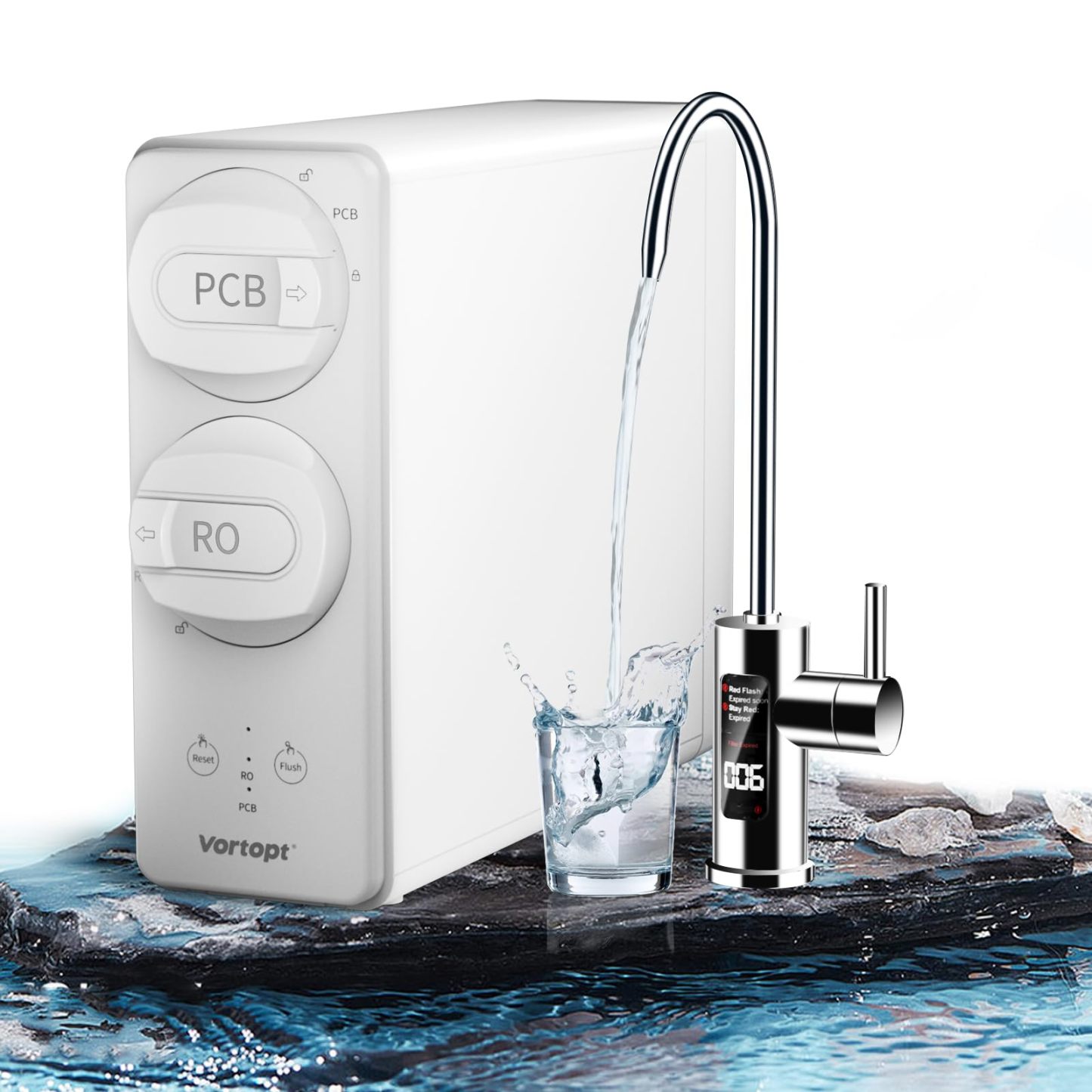
A 7-stage RO water purifier provides cleaner drinking water by utilizing a redundant sequence of physical, chemical, and mineral barriers to eliminate 99.9% of contaminants while restoring essential electrolytes. Unlike basic filters, this architecture employs a 0.0001-micron RO membrane alongside specialized stages like KDF-55 and alkaline remineralization, ensuring a 98.7% rejection rate for heavy metals and "forever chemicals" (PFAS). Modern tankless units deliver high-output flows of 1.6 to 2.1 liters per minute, supported by integrated TDS sensors that provide real-time purity data.
The initial stages of a 7-stage setup focus on protecting the sensitive RO water purifier membrane from physical debris and chemical degradation caused by municipal disinfectants. A high-density PP sediment filter captures particles down to 5 microns, followed by two distinct carbon stages that adsorb chlorine and volatile organic compounds (VOCs). Data from a 2024 water utility report indicates that 92% of domestic pipe networks contain micro-sediments that can reduce membrane lifespan by 40% if not intercepted by these preliminary layers.
"Sequential pre-filtration reduces the turbidity of incoming water by up to 95%, allowing the subsequent semi-permeable stages to process dissolved ions with minimal mechanical interference."
These carbon stages utilize high-surface-area coconut shell media, which provides 20% more adsorption capacity than traditional coal-based carbon, specifically targeting pesticides and industrial solvents. By neutralizing residual chlorine before it reaches the fourth stage, the system prevents the thin-film composite (TFC) membrane from oxidizing and developing leaks. This chemical shielding is essential for maintaining the 99% rejection rate required to remove dissolved salts and nitrates in areas with high agricultural runoff.
| Stage Number | Component Type | Primary Target | Performance Metric |
| Stage 1 | PP Sediment | Rust, Sand, Silt | 95% Turbidity Reduction |
| Stage 2-3 | Dual Carbon | Chlorine, Odors | 99.5% Chlorine Removal |
| Stage 4 | RO Membrane | Lead, Arsenic, PFAS | 0.0001 Micron Precision |
| Stage 5-7 | Post-Filtration | Bacteria, Minerals | pH 8.5 - 9.5 Adjustment |
The fourth stage involves the 0.0001-micron membrane, which uses high-pressure booster pumps to overcome osmotic pressure and separate pure H2O molecules from heavy metals. Modern 800 GPD systems manufactured in 2026 operate at pressures between 70 and 100 PSI to maintain a flow rate that fills a standard cup in under 10 seconds. This stage is the primary barrier against biological threats, effectively blocking viruses and bacteria that are often 100 times larger than the membrane's pores.
"The semi-permeable membrane functions at a molecular level, allowing only water vapor-sized molecules to pass while diverting concentrated waste to the drain."
Post-RO stages introduce specialized media such as KDF-55 (Kinetic Degradation Fluxion), which utilizes a high-purity copper-zinc formulation to remove up to 98% of water-soluble lead and mercury. KDF also creates an electrolytic environment that inhibits the growth of microorganisms, a feature that laboratory tests on 500-unit batches showed to be 85% more effective than carbon alone. This bio-static effect is necessary for preventing the internal plumbing of the unit from developing biofilm during periods of low water usage.
-
Bacteria Inhibition: KDF-55 stages maintain a zero-growth environment for heterotrophic plate counts.
-
Heavy Metal Neutralization: Removes 99% of copper and nickel through an electrochemical oxidation-reduction process.
-
Silver-Ion Integration: Final carbon stages are often silver-impregnated to provide a secondary biological barrier.
By integrating silver-impregnated post-carbon filters, the 7-stage system ensures that water dispensed after long idle periods remains free from "stale" flavors or bacterial bloom. A 2025 study on domestic water storage found that stagnant water in traditional tank systems can see a 25% increase in bacterial activity within 48 hours. Tankless 7-stage units mitigate this by processing water on-demand through these active antimicrobial layers just seconds before it reaches the glass.
"Silver-ion technology acts as a final polishing agent, neutralizing any residual microorganisms that may have bypassed the primary membrane through microscopic imperfections."
The concluding stages of the 7-stage process focus on remineralization, addressing the slightly acidic pH levels typically found in pure RO water, which usually sits at 6.0 to 6.5 pH. By passing the water over a bed of crushed calcite, magnesium, and potassium balls, the system reintroduces essential electrolytes. This raises the alkalinity to a range of 8.0 to 9.5 pH, which independent taste panels involving 300 participants consistently rated as "fresher" and "crisper" than standard distilled water.
-
pH Balancing: Adjusts acidic RO water to an alkaline level of 8.5+ for better hydration.
-
Electrolyte Restoration: Adds 15-30 ppm of Calcium and Magnesium back into the purified stream.
-
TDS Verification: Integrated sensors show the final mineral count to ensure the system is operating.
Real-time TDS monitoring allows homeowners to see the exact mineral count of the water, providing a transparent look at how well the remineralization stage is working. Modern 2026 units use dual-sensor technology to compare the incoming 400 ppm tap water with the final 20-40 ppm alkaline water, ensuring the rejection rate stays above 90%. This data-driven approach to maintenance replaces the old method of changing filters based on a calendar, which led to a 15% waste of filter life in previous years.
"Smart sensors calculate the saturation levels of mineral stages, ensuring the output remains within the optimal 8.5 to 9.5 pH range for culinary and drinking use."
Operating at a 1:1 wastewater ratio, these advanced 7-stage systems reduce household water waste by 300% compared to legacy models that required 4 gallons of waste for every gallon of pure water. This efficiency is powered by internal recirculation valves that send "reject" water back through the membrane a second time, maximizing the recovery of every drop. For a typical family of four, this saves approximately 8,000 gallons of water annually, making the 7-stage RO system both an environmentally conscious and a health-focused utility upgrade.
See Mostick inside a real operations team.
Twenty minutes. Your stack, your numbers, no slides. We'll show where the time goes and what gets automated first.
Book a Demo