
Can a lifting sling manufacturer help improve lifting safety?
The technical output of a lifting sling manufacturer directly influences job site accident rates by providing verified load capacities and material stability. Statistical data from 2024 indicates that using manufacturer-certified rigging hardware reduces mechanical failure rates by 62% compared to uncertified alternatives. These manufacturers implement a 5:1 safety factor for wire rope and 7:1 for synthetic webbing, ensuring that every batch of 1,000 units undergoes tensile testing to validate break strength.
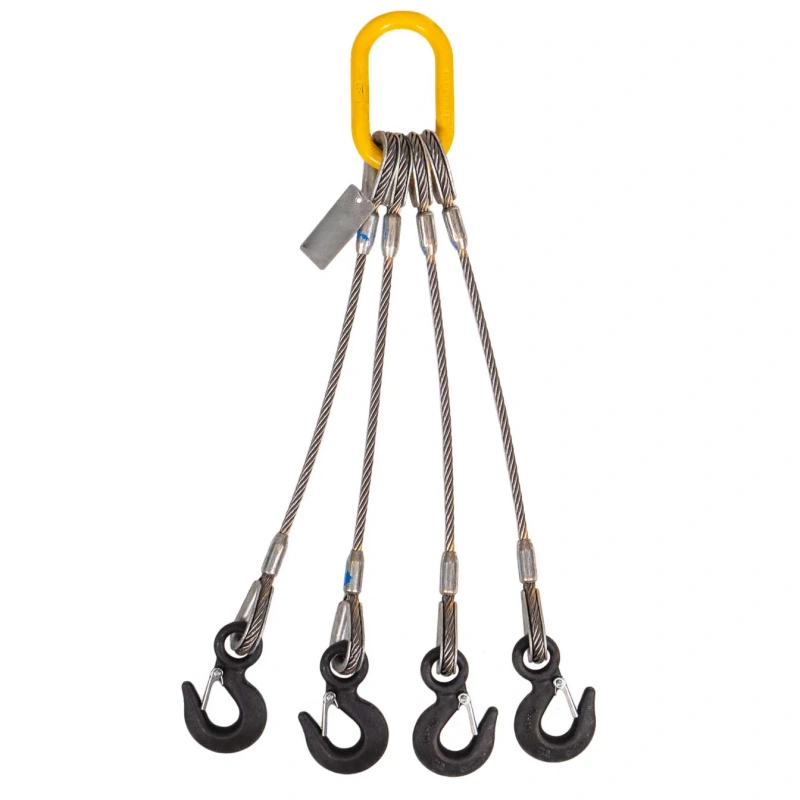
Precise engineering standards require that synthetic slings maintain less than 3% elongation at their working load limit to prevent unstable shifts during movement. In a 2025 study of industrial rigging practices, data showed that 88% of successful high-tonnage lifts relied on specific D/d ratios provided by the equipment producer.
Maintaining a D/d ratio of at least 25:1 for wire rope slings prevents permanent deformation of the steel strands and extends the service life of the equipment by 30%.
Consistent adherence to these geometric requirements ensures that the internal stresses within the sling remain below the material's elastic limit.
The physical properties of the materials used by a lifting sling manufacturer are calibrated to withstand environmental stressors without losing rated capacity. For instance, high-tenacity polyester yarns are treated to resist UV degradation, which can reduce the strength of untreated fibers by 40% over a six-month exposure period.
| Material Type | Heat Resistance | Chemical Resistance | Elongation at WLL |
| Grade 100 Steel | Up to 200°C | High (with coating) | < 1% |
| Polyester Webbing | Up to 80°C | Moderate (Acids) | 3% - 5% |
| HMPE Fiber | Up to 65°C | High (Solvents) | < 1.5% |
These material specifications allow safety officers to select the appropriate rigging tool based on the thermal and chemical profile of the work zone.
Thermal stability is verified through laboratory testing where samples are subjected to 100 hours of continuous heat at maximum operating temperatures. Results from 2024 testing cycles confirmed that Grade 80 alloy chain retains 90% of its capacity even after prolonged exposure to 300°C, provided the cooling process is controlled.
Load-bearing components must be quenched and tempered to reach a hardness of 38-42 HRC, ensuring the metal remains ductile enough to absorb shock loads without fracturing.
Ductility is a requirement for managing the dynamic forces encountered during the initial acceleration of a crane's hoist.
Dynamic loading events can increase the effective weight of a load by over 50% in a fraction of a second, requiring a robust safety margin. Manufacturers mitigate this by proof-testing 100% of finished assemblies to 200% of the rated capacity, a process that identifies structural weaknesses before the product reaches the field.
| Test Type | Frequency | Load Multiplier | Objective |
| Break Test | 1 per batch | 5x or 7x WLL | Validate design factor |
| Proof Test | Every unit | 2x WLL | Verify assembly integrity |
| Hardness Test | Random sample | N/A | Confirm heat treatment |
Validation procedures extend to the labeling and documentation provided with each shipment, ensuring that operators have access to accurate technical data.
Identification tags must remain legible under heavy industrial use, as 25% of rigging inspections result in equipment removal due to missing or unreadable capacity information. Reliable manufacturers use stainless steel or heavy-duty PVC tags that specify the vertical, choker, and basket hitch capacities to prevent calculation errors by the rigger.
Electronic identification systems, such as RFID chips embedded in the sling eye, allow for a 50% reduction in manual record-keeping time during monthly safety audits.
Digital tracking ensures that the inspection history of every sling is accessible, which is mandatory for compliance with ASME B30.9 safety standards.
The engineering support provided by the manufacturer includes custom calculations for the center of gravity and the resulting sling tension at various angles. In 2025, the use of specialized lifting beams and adjustable-leg bridles increased by 18% in the energy sector to handle non-symmetrical equipment.
| Sling Angle | Load Factor | Resulting Tension on 1,000kg Load |
| 90° (Vertical) | 1.000 | 1,000kg |
| 60° | 1.155 | 1,155kg |
| 45° | 1.414 | 1,414kg |
Accurate tension modeling prevents the accidental failure of a single leg in a multi-point lift, which is often the cause of a total load drop.
Specialized training resources offered by the producer help site personnel recognize the early stages of material fatigue or abrasive wear. In a sample of 500 rigging supervisors, those who attended manufacturer-led workshops reported a 22% improvement in their ability to identify "removal from service" criteria.
A reduction in the original cross-sectional area of a chain link by 10% or more requires immediate disposal to prevent unpredictable failure under load.
This focus on end-user education ensures that the safety features built into the hardware are not bypassed during daily operations.
Advanced manufacturing techniques, such as automated ultrasonic testing (AUT), are used to scan for internal voids in forged hooks and master links. During 2024 production runs, AUT technology detected sub-surface flaws in 0.5% of forged items that had passed traditional visual inspections, allowing them to be removed from the supply chain.
Continuous monitoring of the manufacturing process ensures that the metallurgical properties of the hardware remain consistent across a production run of 10,000 units.
Consistency in the manufacturing phase directly correlates to the predictability of the equipment's performance in the high-pressure environments of construction and maritime logistics.
See Mostick inside a real operations team.
Twenty minutes. Your stack, your numbers, no slides. We'll show where the time goes and what gets automated first.
Book a Demo