
Fee Rates in the Calculator: PPS+ vs PPLNS Estimates
Fee estimates go wrong when the rate is applied to the wrong base. Under PPS+ the block reward is settled at the listed 4% rate and the transaction-fee component at a listed 2%; PPLNS replaces those two rates with one, charging a listed 2% across the block reward and the fees together. At 1 PH/s that difference is about $24.23 a month on block-reward income alone, which is more than most hosting quotes vary by.

Key takeaways
- The two methods differ in both rate and base: a listed 4% applies to the PPS-settled block reward under PPS+, with a listed 2% on the transaction-fee component, while PPLNS uses a single listed 2% rate across both.
- At 1 PH/s the block-reward component pays about $1,211.68 a month gross, $1,163.21 after the listed 4% and $1,187.45 at a listed 2%.
- The $24.23 monthly gap between those two bases is fixed arithmetic, not a prediction, and it scales with hashrate.
- Timing differs as well: PPS+ settles hourly at current difficulty, PPLNS pays after six confirmations across the last five difficulty rounds.
Two fee lines, two different bases
A fee rate is only meaningful once you know what it multiplies. At difficulty 132.76 T and an implied network hashrate of 950.3 EH/s, one TH/s earns about 0.0000004735 BTC a day, which is $0.0404 at $85,294 per BTC. Under PPS+, the listed 4% acts on the block-reward part of that income and the transaction-fee part is distributed on a listed 2% basis.
PPLNS is a different construction. The block reward and the transaction fees are combined and distributed under a single listed 2% rate, with payouts following six confirmations and a share measured across the last five difficulty rounds. The rate is lower, and the miner absorbs the variance that PPS+ removes.
The practical consequence is that an estimate labelled with one blended percentage describes neither method accurately. Model the two components separately, then decide which basis you are actually on, because the choice changes the net figure for the same hardware on the same day.
What the difference costs at scale
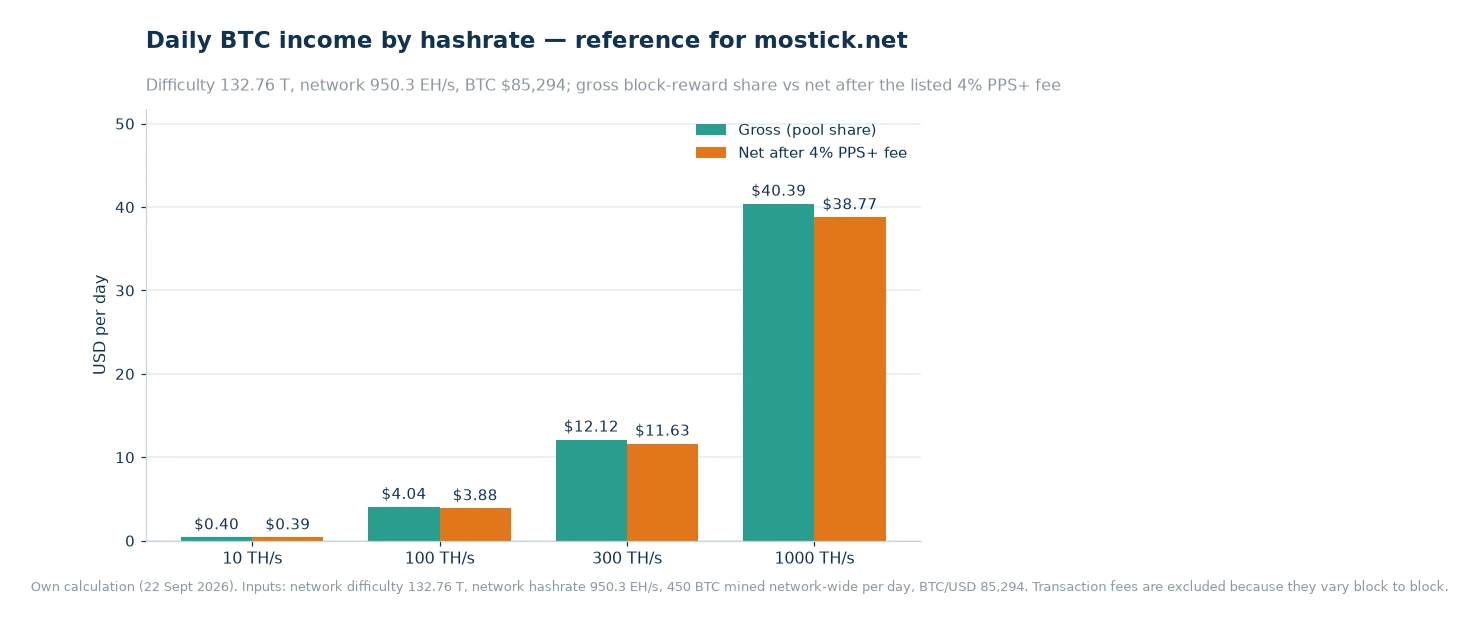
The table holds gross income constant and applies the two listed bases to the block-reward component. The final column multiplies the daily difference by 30 days.
| Hashrate | Gross per day | After the listed 4% | After the listed 2% | Monthly difference |
|---|---|---|---|---|
| 100 TH/s | $4.04 | $3.88 | $3.96 | $2.42 |
| 300 TH/s | $12.12 | $11.63 | $11.88 | $7.27 |
| 1,000 TH/s | $40.39 | $38.77 | $39.58 | $24.23 |
| 10,000 TH/s | $403.89 | $387.74 | $395.81 | $242.33 |
Read the gap as the price of certainty. PPS+ pays a higher rate on the block-reward component because the miner does not carry pool luck or orphan-block risk, and it settles every hour at current difficulty rather than waiting for confirmations. PPLNS pays a lower rate and hands the variance to the miner, which averages out over a long window but not over a week.
Worked example
Take 1 PH/s, which is 1,000 TH/s. Gross income for a 30-day month is 1,000 × $0.0404 = $40.39 a day, or 0.014206 BTC, about $1,211.68 in total.
Apply the listed 4% to the block-reward component and the month becomes $1,163.21. Apply a listed 2% to the same base and it becomes $1,187.45. The difference is $24.23 a month, which is simply 2% of the gross figure, and it does not depend on how profitable the month was in absolute terms, only on how much block-reward income was generated.
Compare the bases at a smaller scale to see how the gap behaves. At 100 TH/s the daily difference is $0.08 and the monthly difference $2.42; at 300 TH/s those figures become $0.24 a day and $7.27 a month. The gap tracks hashrate in a straight line, so it never disappears with size and never rounds away either.
Zoom in to the settlement side. PPS+ credits roughly $1.68 an hour at this hashrate before fees, and about $1.62 an hour after the listed 4%, with 24 credits a day landing against current difficulty. PPLNS pays nothing for hours at a time and then delivers a block-sized amount after six confirmations, spread across the previous five difficulty rounds. Two months can carry identical totals and still look completely different in an account statement.
Modelling both bases in one estimate
An estimate only needs to get three things right: the gross income, the rate, and the component the rate applies to. The ViaBTC Mining Calculator exposes price, difficulty, listed fee and effective hashrate as inputs, so a PPS+ figure and a PPLNS figure drop out of one Profit Calculator run instead of arriving from two spreadsheets written months apart.
Two supporting references are worth bookmarking. The pool statistics page shows the network difficulty the estimate should be using, and the published mining guides explain how each payment method behaves when a block takes longer than usual, which is the scenario variance discussions usually miss.
Why the fee line is the easiest to misread
The common error is adding the two listed PPS+ rates and reporting a single blended figure of 6% on total income. That number does not describe the method, and the difference in the estimate misses it clearly. The exit from the confusion is to keep the real distinction: the listed 2% under PPS+ applies to the transaction-fee component, where the pool takes a smaller share of a smaller and less predictable pool of income.
The second error is applying a current BTC price to a window that has already closed, which inflates or deflates a comparison of the two methods for reasons that have nothing to do with fees. Fix the price and the difficulty, state the basis, and the comparison becomes an honest one. The third error is ignoring payout frequency when managing cash flow, since an hourly schedule and a confirmation-based schedule finance a power bill quite differently.
Settlement frequency also changes how a fee total is experienced. An hourly PPS+ schedule spreads a month across roughly 720 credits, which suits a site paying power on a monthly cycle and makes a hashrate dip visible within a day. A PPLNS schedule concentrates income into fewer, larger events after confirmations, and a small fee difference against a lumpy payout can look much bigger than it is.
Frequently asked questions
Is the PPS+ fee really 6% on everything?
No. The listed rates are 4% on the PPS-settled block reward and 2% on the transaction-fee component, which are different parts of the payout. Adding them into one percentage on total income describes a fee that is not charged.
Which method pays more over a month?
On the block-reward component a listed 2% base leaves more than a listed 4% base: about $24.23 more per PH/s per month at this difficulty. PPLNS also carries payout variance, so a single month can land either side of that difference.
How often does each method pay?
PPS+ settles every hour against current difficulty. PPLNS pays once a block has six confirmations, with the reward shared according to each miner's contribution across the last five difficulty rounds.
Write the basis next to the number
Any net income figure without a payment basis attached is incomplete, so record the two together and re-run them when difficulty moves. Run a gross-versus-net comparison at your own hashrate for both listed bases, then decide whether the lower rate is worth carrying the variance. The arithmetic is short, the difference is measurable, and it changes what a fleet is worth over a year.
Notes and sources: the ViaBTC listed fee schedule[1], pool statistics[2] and the published mining guides[3]. Network difficulty 132.76 T, implied network hashrate 950.3 EH/s, the 3.125 BTC subsidy behind 450 BTC a day network-wide and the $85,294 BTC price were read 22 Sept 2026. The numbers here are multiplications rather than expectations, and they move whenever difficulty or price does; read them as a worked comparison of the two fee bases, not as a statement about what any pool or machine will pay.